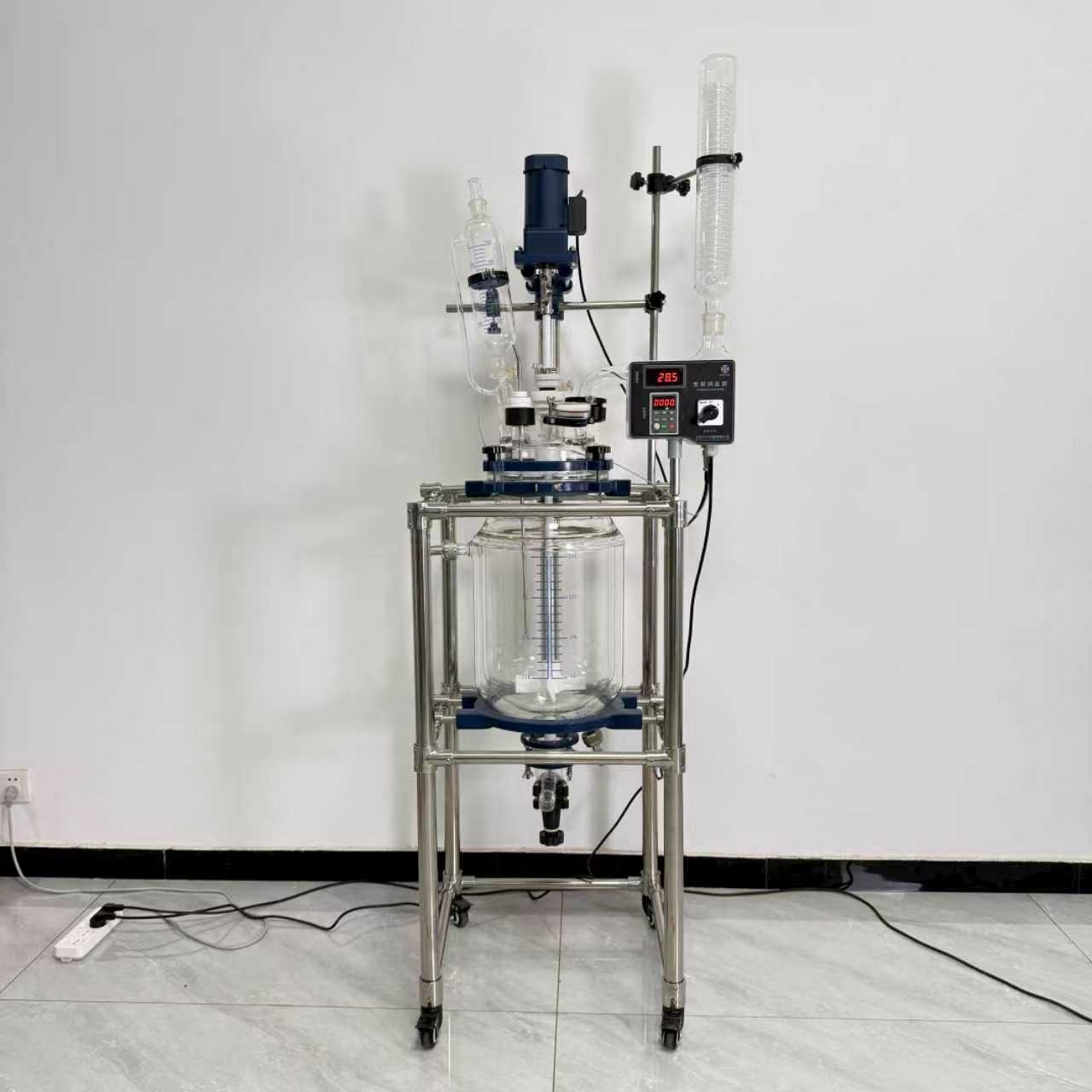
Glass reactors are widely used in various chemical reactions due to their high transparency, corrosion resistance, high-temperature tolerance, ease of cleaning, and ability to facilitate observation of reaction processes. Below are some types of chemical reactions suitable for glass reactors:
I. Organic Chemical Reactions
· Esterification reactions: Such as the process where carboxylic acids react with alcohols to form esters.
· Synthesis reactions: Used to synthesize various organic compounds.
· Redox reactions: Chemical reactions involving electron transfer, such as the oxidation of alcohols or alkenes.
II. Material Synthesis
· Compound synthesis: Capable of synthesizing diverse compounds, including both inorganic and organic materials.
· Crystal synthesis: Used to synthesize various crystalline materials.
· Nanoparticle synthesis: Leveraging the precise control conditions of glass reactors enables the synthesis of nanoparticles.
III. Ultrasonic Reactions
· Due to the smooth interior surface of glass reactors, ultrasonic waves readily resonate on the glass surface, making them suitable for ultrasonic reaction experiments.
IV. High-Temperature and Low-Temperature Reactions
· High-Temperature Reactions: Glass reactors can perform reactions at elevated temperatures (up to 220°C), suitable for chemical reactions requiring high temperatures.
· Low-Temperature Reactions: By circulating cryogenic fluids through the jacket, glass reaction vessels can also operate at low temperatures (down to -80°C), suitable for chemical reactions requiring cryogenic conditions.
V. Other Specialized Reactions
· Vacuum and Negative Pressure Reactions: Glass reaction vessels can be evacuated for negative pressure reactions.
· Distillation Reflux Reactions, Vacuum Distillation Reactions, Separation/Extraction Reactions, and Purification Reactions: These represent significant applications of glass reaction vessels.
VI. Application Fields
· Chemical Field: Commonly used for synthesizing polymers, catalysts, nanomaterials, etc.
· Biological Field: Suitable for cell culture, protein crystallization, enzyme catalysis experiments, etc.
· Pharmaceutical field: Employed in drug synthesis and drug stability studies.
· Other fields: Also utilized in food processing, food fermentation, environmental experiments (e.g., wastewater and exhaust gas treatment), and medical experiments (e.g., drug screening and efficacy evaluation).
5L Glass Reactor 01
Overall, glass reactors adapt to diverse chemical reactions due to their unique material and design.
This text is generated by AI.
